
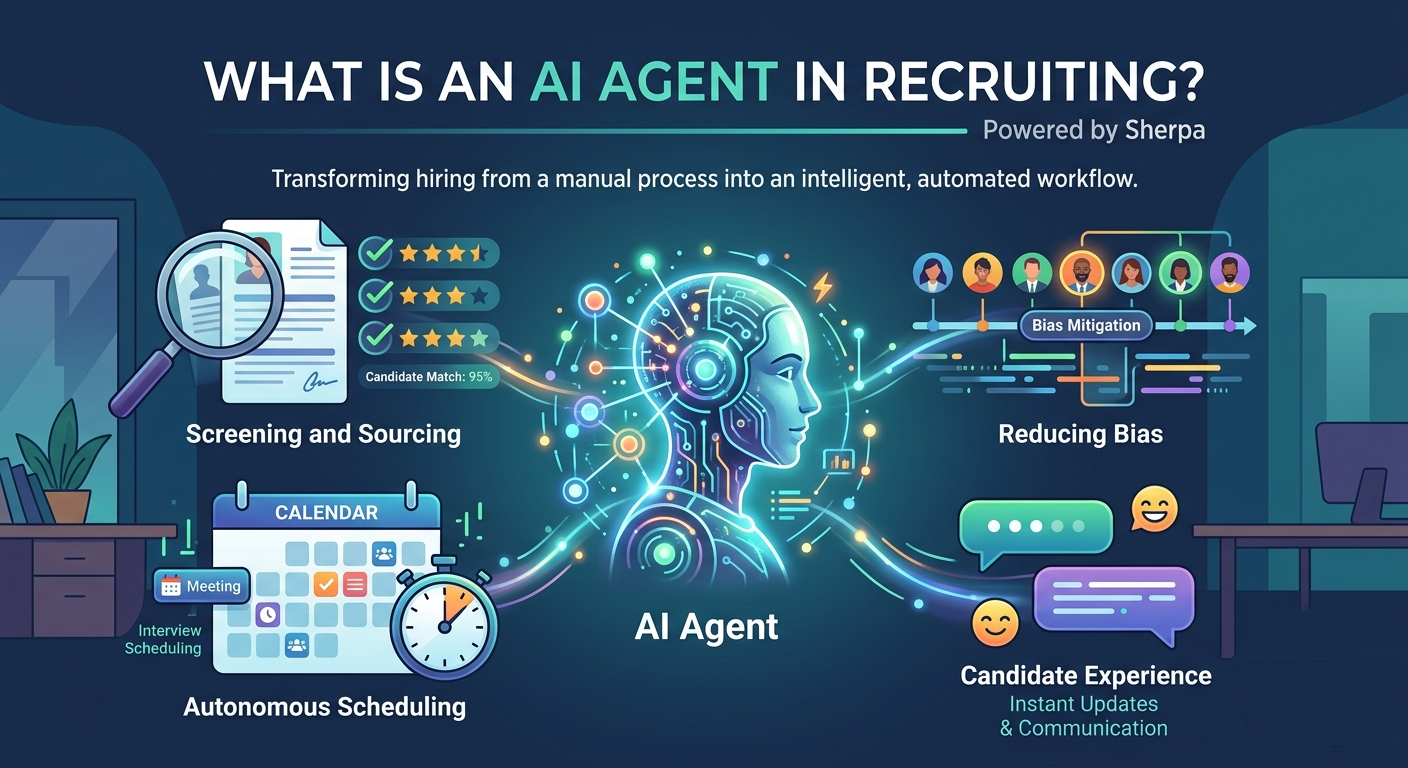
The hiring landscape is changing fast. Across industries, HR teams are discovering that AI agents can take on many of the repetitive, time-consuming tasks that once slowed down their recruiting pipelines. What was once a slow, manual process is now becoming an intelligent, automated workflow — and the organizations that adapt earliest are already pulling ahead.
Traditional automation follows a straight line: if X happens, do Y. An AI Agent, however, is designed to operate with a level of autonomy and reasoning. In recruiting, this means the system doesn't just store resumes; it actively pursues goals. Whether it’s scouring LinkedIn for the perfect technical lead or managing real-time candidate queries, an agent acts as a digital teammate that can make informed micro-decisions to keep your pipeline moving.
Traditional recruitment involves hours of manual work: reading hundreds of résumés, comparing candidates, coordinating interview slots, and sending follow-up emails. AI agents now handle much of this autonomously. They can identify talent based on complex job requirements, rank candidates by functional fit, and even initiate the first outreach.
What used to take a recruiter an entire week can now be completed before lunch. The agent scans profiles with a deep understanding of skill sets, scores each candidate against the specific nuances of your role, and produces a ranked shortlist. Even the "scheduling dance" happens automatically through integrated workflows, removing one of the most frustrating administrative hurdles in the hiring process.
What sets modern AI recruiting agents apart from basic keyword filters is their ability to understand context. A well-designed agent can identify transferable skills, flag potential experience gaps, and even surface "hidden gem" candidates who might not have the exact job title you searched for but possess the perfect background.
This distinction is vital. Simple software breaks the moment a candidate’s background doesn’t fit a predefined template. AI agents, by contrast, can recognize that a candidate from a tangential industry brings exactly the cross-functional experience a growing team needs. They don't just follow rules—they interpret intent.
AI agents also improve the candidate experience. Faster response times, clearer communication, and more relevant job matches mean applicants feel respected and heard — even at scale. For HR teams, the result is more bandwidth to focus on relationship building and the high-level strategic decisions that require a human touch.
Candidates today expect a fast, transparent process. An AI agent can acknowledge applications instantly, provide status updates, and answer common questions about the company culture—all without adding a single task to the recruiter’s to-do list.
One of the most impactful benefits of AI recruiting agents is their ability to mitigate unconscious bias. Human screeners, even well-intentioned ones, can be influenced by factors unrelated to job performance. AI agents, when properly configured, evaluate every candidate against the same objective criteria, consistently and without fatigue. By focusing exclusively on skills, experience, and demonstrated results, agents help build more diverse shortlists and fairer outcomes for all applicants.
Companies adopting AI agents report significant reductions in time-to-hire and a noticeable increase in the quality of their talent pool. The goal isn't to replace the recruiter, but to empower them. When the agent handles the volume and the logistics, the recruiter is free to handle the judgment and the human connection.
The shift to agent-led recruitment isn't a distant trend; it's the new standard for staying competitive.
Ready to see what an AI Agent applicant tracking system looks like in action? Sherpa combines ATS, CRM, sourcing, and analytics in one platform, with AI built into every workflow. Request a demo.

Stop managing your ATS.
Let Sherpa run it for you.