
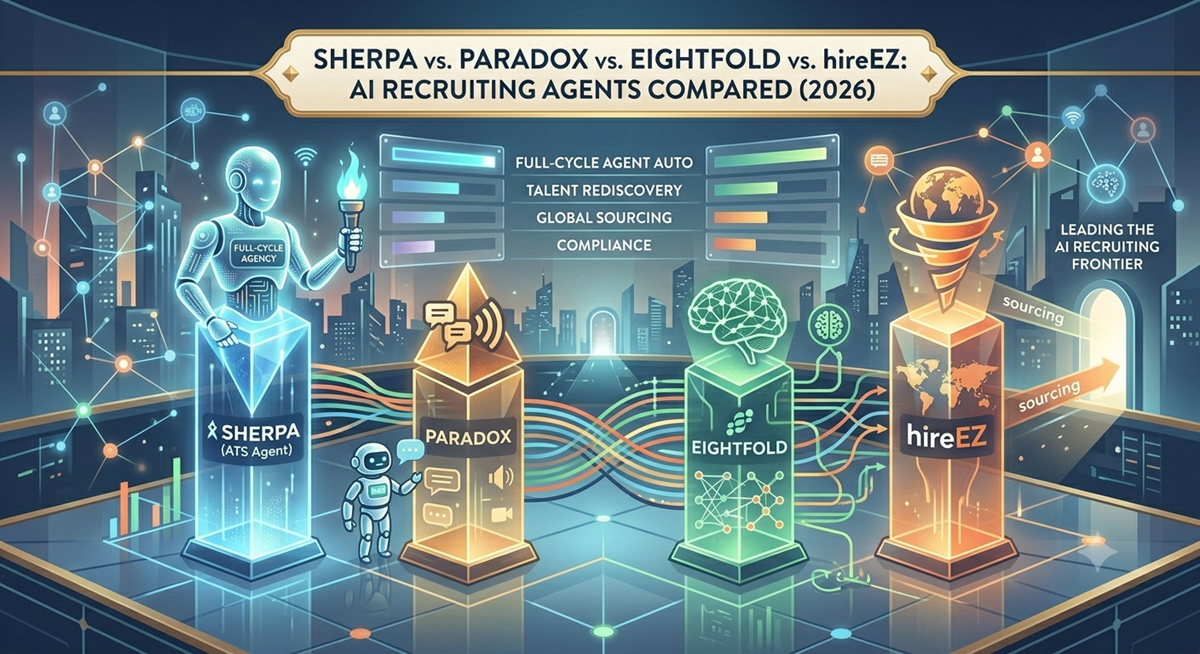
En 2026, la expresión «agente de reclutamiento con IA» se ha convertido en una de las más usadas —y más desgastadas— del marketing de HR tech. Pero detrás de esa misma etiqueta se esconden productos que funcionan de maneras muy distintas. Algunos añaden una capa conversacional sobre un sistema de seguimiento de candidatos (ATS) que de todos modos hay que comprar por separado. Otros construyen motores de coincidencia de talento muy sofisticados, pensados para empresas con años de datos históricos de contratación. Otros se centran únicamente en buscar candidatos en la web abierta y dejan el resto del proceso al ATS que ya se esté usando.
Sherpa adopta un enfoque distinto: un ATS completo con un agente conversacional de IA integrado en su núcleo, que permite a un reclutador gestionar todo el proceso de contratación —publicar una vacante, buscar candidatos, evaluar solicitudes, programar entrevistas, gestionar el pipeline— mediante simples comandos en lenguaje natural, en una sola plataforma.
Para ayudar a los equipos de reclutamiento a ver con claridad entre tanta oferta, este artículo compara Sherpa con tres de los nombres más reconocidos del reclutamiento impulsado por IA: Paradox (Olivia), Eightfold AI y hireEZ.
Antes de comparar plataformas concretas, conviene tener claro qué criterios las distinguen realmente:
| Sherpa | Paradox (Olivia) | Eightfold AI | hireEZ | |
|---|---|---|---|---|
| Producto principal | ATS completo + agente de IA | Capa conversacional de evaluación/programación | Plataforma enterprise de inteligencia de talento | Plataforma de búsqueda y contacto en la web abierta |
| Sustituye a tu ATS | Sí | Normalmente se combina con un ATS existente | Normalmente se combina con un ATS existente | No — diseñada para funcionar junto a un ATS |
| El agente de IA cubre todo el pipeline | Sí (publicar, buscar, evaluar, programar, gestionar) | Sobre todo evaluación + programación | Coincidencia + redescubrimiento de talento | Búsqueda + contacto |
| Búsqueda en LinkedIn / web abierta | Sí, campañas automatizadas | Limitada | Redescubrimiento dentro de los datos existentes | Sí, base de datos de más de 800 M de perfiles |
| Precios | Planes Business/Enterprise públicos | Cotización personalizada, contratos que suelen partir de unos 50.000 $/año | Cotización personalizada, generalmente 80.000–150.000 $+/año | No publicados, aprox. 169–250 $+/usuario/mes, contrato anual medio de unos 13.000 $ |
| Ideal para | Equipos de RR. HH. pequeños y medianos, organizaciones en crecimiento | Grandes empresas, contratación de alto volumen por horas | Grandes empresas con grandes volúmenes de datos históricos | Equipos mid-market/enterprise que necesitan búsqueda saliente a gran escala |
El producto de Paradox se basa en Olivia, una asistente conversacional de IA que interactúa con los candidatos por SMS y chat, los evalúa con preguntas de calificación, programa entrevistas según la disponibilidad de los reclutadores y envía recordatorios, todo de forma ininterrumpida y en más de 100 idiomas. Es una experiencia pensada ante todo para móviles: los candidatos solicitan puestos de alto volumen y por horas, e interactúan casi exclusivamente por texto en lugar de un formulario de solicitud tradicional.
Esto hace que Olivia sea especialmente eficaz en sectores con un volumen de contratación constante y repetitivo —comercio minorista, hostelería, salud, logística—, donde el principal cuello de botella suele ser la rapidez para programar entrevistas y no la búsqueda de candidatos. La mayoría de las implementaciones de Paradox se añaden a un ATS existente en lugar de sustituirlo; Paradox se integra con las principales plataformas ATS sin ser una en sí misma.
Las contrapartidas: la tarificación se realiza mediante cotización, y los contratos reportados suelen partir de unos 50.000 $ al año, lo que deja fuera a los equipos más pequeños. El análisis de currículums también es comparativamente superficial: Olivia se apoya sobre todo en respuestas conversacionales estructuradas en lugar de un análisis documental profundo, por lo que se adapta mejor a preguntas de calificación que a una evaluación matizada de candidatos.
Ideal para: grandes empresas con contratación de alto volumen y repetitiva, que ya cuentan con un ATS y desean añadirle una capa conversacional.
Eightfold adopta un enfoque fundamentalmente distinto. En lugar de evaluar a los candidatos frente a una sola descripción de puesto, la plataforma construye un perfil de talento persistente para cada persona que alguna vez haya pasado por el pipeline de contratación —empleados, antiguos candidatos, contratistas— y utiliza una ontología de habilidades para inferir capacidades que nunca aparecen explícitamente en un currículum. Un desarrollador backend con tres años de experiencia en pipelines de datos, por ejemplo, puede aparecer como un candidato sólido para un puesto de machine learning, aunque ese término no figure en ninguna parte de su trayectoria.
Este enfoque hace que Eightfold sea especialmente eficaz para el redescubrimiento de talento y la movilidad interna en grandes organizaciones; algunas empresas que la usan reportan un aumento notable de candidatos de grupos subrepresentados que llegan a la fase de entrevista, un efecto secundario de basar la coincidencia en habilidades y potencial en lugar de en la trayectoria académica.
Ese poder tiene un coste en complejidad. Obtener resultados útiles suele requerir entre tres y seis meses de limpieza de datos, ya que el motor de coincidencia solo es tan bueno como los datos históricos que lo alimentan. Los reclutadores acostumbrados a las búsquedas booleanas a menudo describen una curva de aprendizaje real. Eightfold se dirige casi exclusivamente a grandes empresas: el precio no es público, pero los contratos reportados suelen situarse entre 80.000 y 150.000 $ o más al año, con poco interés en empresas de menos de unos 500 empleados.
Ideal para: grandes empresas con años de datos históricos de candidaturas, recursos dedicados a la implementación y una estrategia de contratación basada en habilidades o movilidad interna.
hireEZ —antes Hiretual— es una plataforma de búsqueda de talento con IA agéntica diseñada para encontrar y contactar candidatos en la web abierta: LinkedIn, GitHub, Stack Overflow, patentes y publicaciones académicas, a partir de una base de datos que asegura superar los 800 millones de perfiles. Su función más destacada es el «redescubrimiento ATS», que vuelve a sacar a la luz candidatos cualificados que ya están en la base de datos de candidaturas existente de una empresa, reduciendo el coste de buscar a personas a las que ya se atrajo una vez. También ejecuta secuencias de contacto automatizadas de varios pasos y se conecta con más de 45 plataformas ATS mediante sincronización bidireccional.
La distinción importante: hireEZ no es un sistema de seguimiento de candidatos. Está diseñado explícitamente para funcionar junto al ATS que un equipo ya utiliza: busca y contacta candidatos, y luego los transfiere. El precio tampoco es público; las referencias del sector sitúan el coste por usuario entre aproximadamente 169 y 250 $ o más al mes, con un contrato anual medio de unos 13.000 $, y varios compradores reportan aumentos de precio en la renovación de entre el 15 % y el 30 % de un año a otro, en ocasiones más.
Ideal para: equipos mid-market y enterprise que ya cuentan con un ATS independiente y necesitan escalar la búsqueda saliente para puestos técnicos o especializados difíciles de cubrir.
El patrón en los tres competidores anteriores es el mismo: cada uno hace muy bien una parte del proceso de contratación, y asume que ya se cuenta con el resto de la pila tecnológica, o que se comprará por separado. Paradox gestiona las conversaciones de evaluación y programación. Eightfold gestiona la coincidencia profunda de talento. hireEZ gestiona la búsqueda en la web abierta. Ninguno de los tres es, por sí solo, un sistema de seguimiento de candidatos.
Sherpa está construido al revés. El agente de IA no es una capa añadida sobre el ATS: es la forma principal en que los reclutadores usan el ATS. Un reclutador puede pedirle a Sherpa que publique una vacante, lance una campaña de búsqueda en LinkedIn para un puesto y una ubicación concretos, puntúe y clasifique automáticamente las solicitudes recibidas, y programe entrevistas a través de Google Calendar, Outlook o Apple Calendar, todo dentro de una sola conversación, sin pagar por herramientas independientes de búsqueda, evaluación y programación añadidas a una licencia de ATS básica.
Hay otras dos diferencias relevantes para quienes comparan estas plataformas:
Transparencia de precios. Los planes Business y Enterprise de Sherpa son públicos, no están ocultos detrás de una llamada comercial y una cotización personalizada. Para un equipo de RR. HH. pequeño o mediano que necesita definir un presupuesto antes de comprometerse —exactamente el tipo de comprador para el que un contrato anual de 50.000 a 150.000 $ con Paradox o Eightfold no es realista—, esto importa.
Adecuación al tamaño de la empresa. Paradox y Eightfold están construidos para grandes empresas; hireEZ se tarifica y se posiciona como un complemento para equipos que ya cuentan con una infraestructura de ATS independiente. Sherpa está construido para equipos de RR. HH. pequeños y medianos, así como para organizaciones en crecimiento que quieren capacidad de agente de IA sin pasar por un ciclo de compra enterprise ni acumular varias herramientas que licenciar e integrar.
En cuanto a los datos, Sherpa mantiene la información de cada empresa en un ámbito aislado con su propio vector store, funciona sobre una arquitectura de IA sin estado para que el historial de conversaciones se almacene en la base de datos de la propia empresa en lugar de en los servidores de un proveedor de IA externo, y redacta automáticamente la información personal identificable durante el análisis de currículums. La plataforma también admite de forma nativa inglés, francés y español, y el agente de IA responde automáticamente en el idioma de quien le habla, algo relevante para cualquier organización que contrate simultáneamente en América del Norte, Europa y América Latina.
Las cuatro plataformas apuntan en la misma dirección: menos tareas administrativas manuales, y una parte cada vez mayor del proceso de contratación delegada a un agente de IA. La elección correcta depende menos de qué plataforma tiene la lista de funciones más larga, y más de lo que realmente se necesita: un complemento de búsqueda, una capa de evaluación, un motor de coincidencia de talento pensado para una empresa con años de datos, o un único agente conversacional que gestione todo el pipeline de contratación desde una plataforma con precios transparentes.
Si esta última opción es la que buscas, reserva una demostración personalizada de Sherpa para ver al agente de IA ejecutar un proceso de contratación real de principio a fin.

Deja de gestionar tu ATS.
Deja que Sherpa lo haga por ti.